- Details
The Sovereign Crown of the Mauri Nation Rangatira did the undertaking and completion of the Salvage Claim, to secure the flag, on behalf of the original owners who gathered to select the Te Kara Flag 1834 at Waitangi.
Some of the Chiefs were Te Rēweti Atuahaere, Hōne Heke Pōkai, Moka Te Kainga-mataa, Te Wharerahi
Tāmati Wāka Nene, Rewa, Kiwikiwi Makoare Te Taonui, Eruera Pare Hongi.
These chiefs, along with others, participated in the selection of the flag, which became a symbol of Māori unity and identity.
The Rangatira 'Lady Crown Chieftainess Turikatuku III' that did the salvage claim on behalf of tupuna, is a descendant herself of Ariki Hongi Hika and Tuirkautuku III.
Ariki Hongi Hika travelled to England to met with King George III to initiate protection for Mauri and Aoteaora, along with the flag and the declaration.
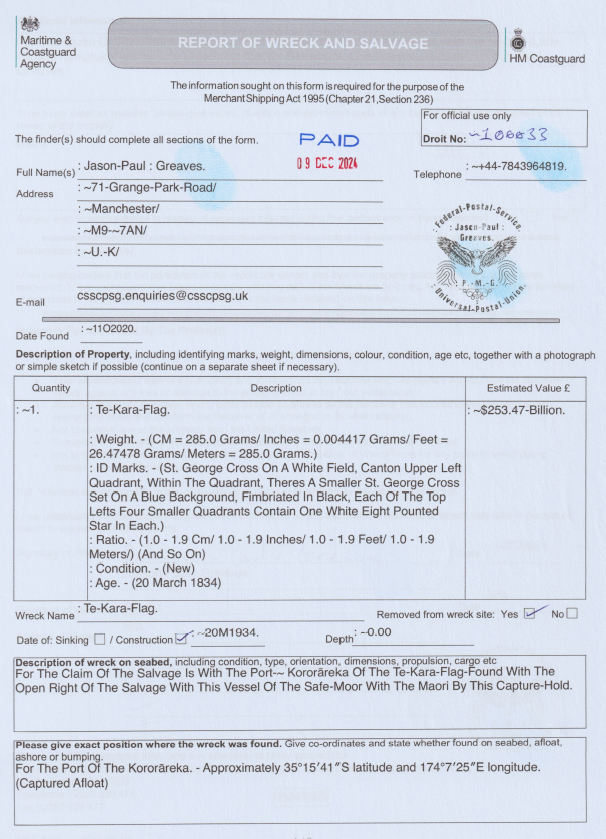
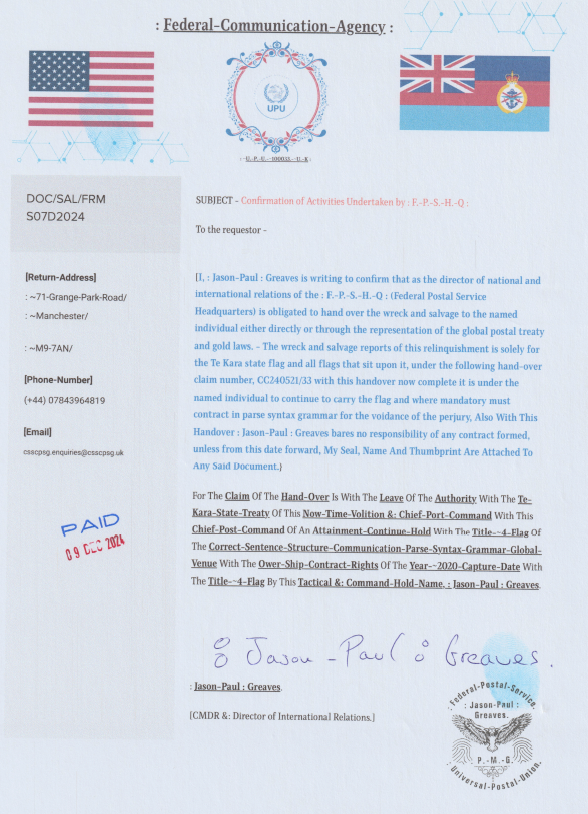
:Jason-Paul: Greaves.
:Global-Chief-Post-Master-General.
:Lady-Crown-Chieftainess: Turikatuku III.
:General-Post-Master-Aotearoa.
- Details
The Sovereign Crown of the Mauri Nation
Internationally Recognised by the Sovereign Nations of Ireland, England and Scotland 3rd Oct 2024
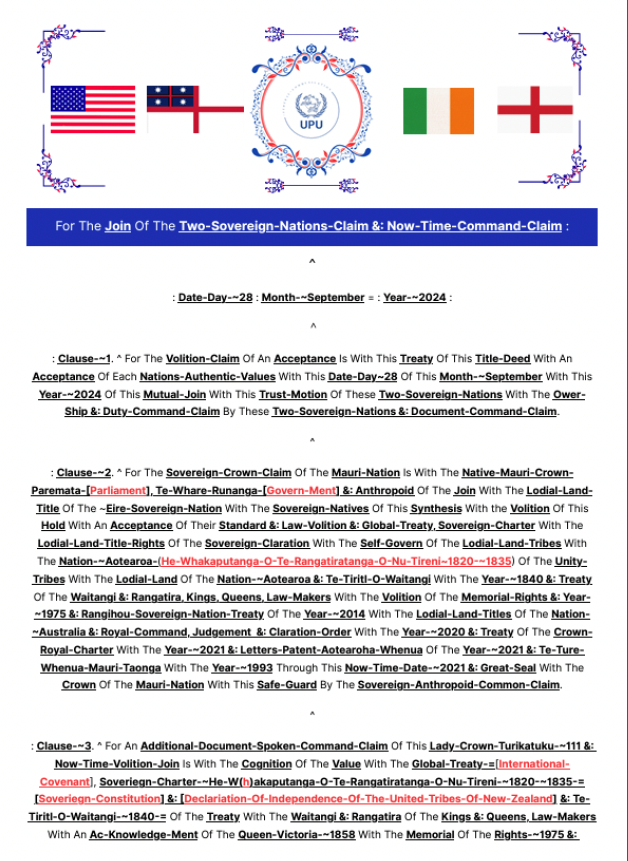
This document outlines a treaty between two sovereign nations: the Crown of the Mauri Nation and the Sovereign Nation State of Éire (Ireland). The treaty, dated September 28th, 2024, establishes mutual recognition, cooperation, and shared governance. Key aspects include: *Core Claims and Agreements:* * *Mutual Recognition of Sovereignty:* Both nations acknowledge each other's sovereignty and authentic values. * *Joint Trust and Command:* A joint trust motion asserts ownership, duty, and command over the treaty and its documentation. * *Historical Context:* The treaty explicitly references various historical treaties, declarations, and legal claims related to the sovereignty of indigenous Māori in Aotearoa (New Zealand) and the historical claims of Éire. These include He Whakaputanga o te Rangatiratanga o Nu Tireni (1835), Te Tiriti o Waitangi (1840), and other key documents highlighting significant milestones in the history of both nations. * *Lodial Land Claims:* Both nations assert claims over specific lodial (ancestral) lands within their respective territories. * *Appointment of Postmasters:* John Flanagan is appointed as Postmaster General for both nations. * *Now-Time Claims:* The treaty utilizes the term "Now-Time" to emphasize the current and ongoing validity of the claims made. * *Global Postal Treaty Compliance:* The treaty adheres to rules related to the Global Postal Treaty, encompassing syntax and grammatical structures. *Key Individuals and Entities:* * *Lady-Crown-Turikatuku-111:* A central figure in the treaty, seemingly representing a significant role in asserting both Crown claims. * *Jason-Paul Greaves:* Identified as the Global Chief Post Master General, playing a significant role in verifying and endorsing the treaty. * *Mauri Crown & Eire Crown:* The treaty acknowledges the sovereignty and authority of both Crown entities. *Geographical Context:* The treaty includes maps illustrating the Maritime Limits of both New Zealand and Éire. *Disclaimer:* This summary is based on the provided text. The legal implications and full details of this treaty require expert analysis. For legal or official interpretations, consultation with relevant legal professionals is recommended.
Clause 1 - A Mutual Treaty of Volition and Acceptance: Each nation accepts the treaty and the title-deed. The Authentic Values of both nations acknowledge the authenticity of their mutual values. The agreement is dated September 28, 2024. The Trust and Command is these nations agree to a joint trust motion, asserting ownership, duty, and command over the terms of the treaty and the documentation. This treaty emphasizes sovereignty and cooperative governance.
Clause 2 - The clause is referencing a series of our historical treaties, declarations, and legal claims involving the sovereignty of indigenous nations, particularly in Aotearoa [New Zealand] and Gondwana[Australia]. The mention of documents such as He Wakaputanga o te Rangatiratanga o Nu Tireni, 1835 (Declaration of Independence) &: Te Tiriti o Waitangi 1840(Treaty Of The Waitangi) &: Letter from Queen Victoria 1858 addressing Rangatira, Kings, Queens, Law-Makers &: Memorial of Rights 1975 &: Rangihou Sovereign Nation Treaty Gondwana[Australia] 2014 &: Royal Decree Command Judgement 2020 &: Crown Royal Charter 2021 &: Letters Patent Aotearoa[New Zealand] Whenua 2021 &: Te Ture Whenua Maori Maori Land Act 1993 which highlights significant milestones in the Mauri Nations legal and colonial history. These are foundational to the recognition of Mauri rights and sovereignty.
Clause 3 - This clause is referencing various legal and historical documents related to the sovereignty and land rights of the Mauri(Maori) people in Aotearoa [New Zealand]. It highlights the relationships of He Wakaputanga o te Rangatiratanga o Nu Tireni, 1835 (Declaration of Independence) &: Te Tiriti o Waitangi, and the concepts of sovereignty, land titles, and governance. It emphasizes the Sovereignty Claims of the Sovereign Crown of the Māuri Nation and their rights over land and governance. It mentions significant historical treaties, declarations and agreements that establish and reaffirm these rights. It discusses the legal foundations for the Mauri(Maori) governance structure and the relationship with the Settlers Parliament.
Clause 4 - This clause describes the appointment of Lady-Crown-Tuikatuku-111 and John: Flanagan as Post-Masters over the lodial land title locations of Aotearoa [New Zealand] and Éire. This appointment is recognized under a formal Global Postal Treaty Document Command Claim, with a specific date of September 28, 2024. These sovereign individuals, live life claimants are granted authority through this global postal treaty, and the claim includes acknowledgment of the sovereignty and duties tied to these lodial land title locations.
Clause 1.2 - Asserts the compliance command claim of the sovereign nations concerning the IRB location in Éire Territory and location of the Sovereign Crown of the Mauri Nation. It emphasizes the current authority of each nation and their alignment with the Global Postal Treaty and Global Gold Laws within the context of commerce and lodial land contracts. This clause highlights the ongoing authorization and governance by the sovereign postal nations and their membership in global agreements, finalized by Global Chief Post Master General, Jason-Paul Greaves.
- Details
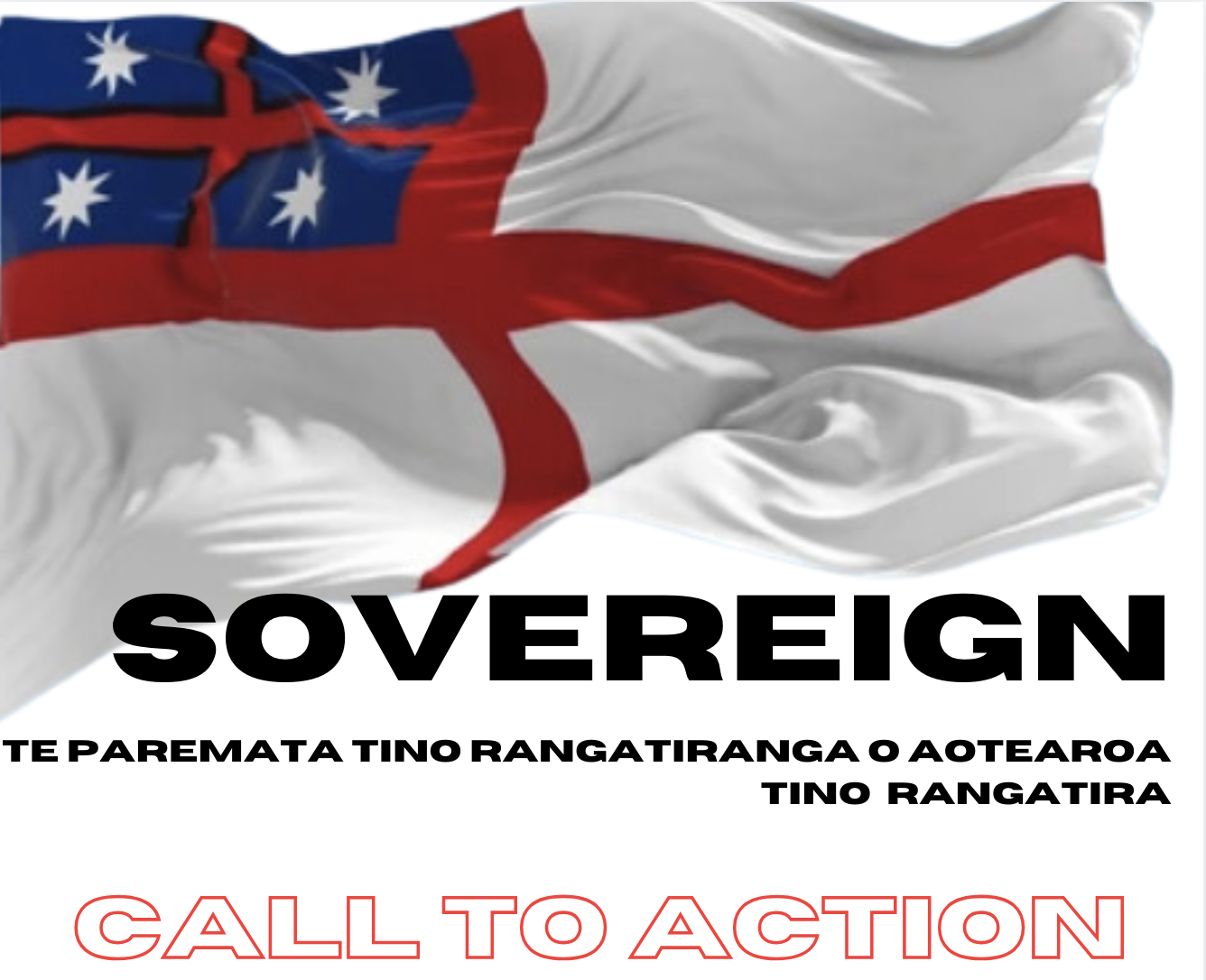
Are you Sovereign? Are you Tino Rangatira? Are you prepared to embrace your role as a chief for your Hapu? Are ready to make laws for self-determination, leadership, and kaitiakitanga over your Maori lands?
Are you ready to assert your authority as Tino Rangatira and stand united with us as part of a collective force for our people?
We, the Nation’s Sovereign Tino Rangatira, will convene Te Kooti o te Rangatiratanga on 4th February 2025 at Waitangi, standing together in our collective private capacity to re-affirm our letters patent & laws, to re-establish the Sovereign Upper House, and formalise the Mauri Legislative Privy Council. Through this, we shall assert our unqualified chieftainship, our independence and governance of our Sovereign Crown of the Mauri Nation as mandated in Te Tiriti o Waitangi 1840. We shall reaffirm our Sovereign power, authority, and control over our Maori lands, exercising our full rights, powers, and privileges as guaranteed under He Wakaputanga o te Rangatiratanga o Nu Tireni 1835, Article 2.
Our sovereign heirs and unextinguished native title—He Taonga Tuku Iho—shall remain protected and upheld under our laws, governed by the kawanatanga, manakitanga and principles guaranteed in He Wakaputanga o te Rangatiratanga o Nu Tireni 1835 and Te Tiriti o Waitangi 1840. No external corporate entity or authority shall infringe upon this enduring sovereignty.
All unextinguished native title authority shall be lawfully upheld, ensuring that lands remain collectively retained by the Sovereign Tino Rangatira, as guaranteed under Te Tiriti o Waitangi 1840. Since the first option of land purchase by the Crown was never exercised, these lands rightfully remain under our collective authority. Additionally, the Foreshore and Seabed Decision 2004 confirms the invalidity of imposed land titles, further affirming our sovereign authority and ancestral rights.
This is a call to all Sovereign Tino Rangatira who wish to join the collective Tino Rangatira, represent their hapu, fulfill the legacy entrusted to us by our ancestors, and honour the spirit of Te Kara Flag 1834, He Wakaputanga o te Rangatiratanga o Nu Tireni 1835, Te Tiriti o Waitangi 1840, and the mana of our tupuna. Together, we will uphold the sovereign principles of KOTAHITANGA, justice, unity, and self-determination, standing resolute in our Sovereign Upper House as the voice and aspirations of our people.
This is a CALL TO ACTION FOR SOVEREIGNS, a declaration of leadership, and a steadfast commitment to the future of our nation. Together, we stand united to honor and protect the mana of our tupuna, ensuring that our lands, rights, and heritage are upheld with integrity and sovereignty, free from corporate interference or exploitation.
Location: WAITANGI GROUNDS - Location emailed to all Tino Rangatira 24hrs prior
Date: 4th February 2025
Time: 10.00am - Noon
Please Note: All Sovereign Tino Rangatira must provide proof of Sovereignty - Live Life Claim or Affidavit of Life. This is to ensure that you have taken the required steps as Rangatira and that you are not standing in the public as a corporate subject of the corporate regime with the Company of New Zealand. Kupapa and Corporate entities will be removed from these proceedings.
Click Here - Tino Rangatira Can Join Us Here and Stay Updated
Click Here - To Get a Live Live Claim
- Details
PRIVATE NOTICE
RE: Janine of the House of Arabella and her Crown role in the public arena.
Please be advised that the role that Janine of the House of Arabella is upholding as ‘crown over the corporations’ now and during the course of her actions against the corporations, is one that she has taken ONLY OVER CORPORATIONS; a role that was vacated by the Crown of England. At no time does this role ‘interfere’ or is ‘superior’ to that of the Sovereign Crown of the Mauri Nation position or our processes.
Janine does not have any jurisdiction or authority over sovereigns of the Sovereign Crown of the Mauri Nation, Live Life claims, private foundations, Native Earth Claims, Whenua Exclusive Deeds, Unextinguishd NATIVE title, He Wakaputanga o Te Rangatiratanga o Nu Tireni 1820-1835 in perpetuity, Te Tiriti o Waitangi 1840 in perpetuity, Mana Motuhake, Tino Rangatiratanga, Te Kara Flag 1834, Royal Crown Charter, Self-Governance, Letters Patent, Sovereign Mauri Paremata, Sovereign Mauri Government, Purple Thumb Community, General Post-Master and Post-master roles, Sovereign Travel Permits, Private Notaries, the ‘Crown’ trademark and all other intellectual property belonging to the Sovereign Crown of the Mauri Nation.
Her jurisdiction as Crown is over companies incorporated under the Companies Act 1993 that the Crown wholly owns.
Janine has been warned that if she crosses the line and attempts to manage the affairs for Native Mauri, then we will stand her down effective immediately.
- Details

Te Kara Flag 1834
The Te Kara Flag holds much significance to Mauri people as the first official flag of Aotearoa - Te Rui a Maui as an independent, self-governing nation. He Wakaputanga o te Rangatiratanga o Nu Tireni 1835 [Declaration of Independence] confirms that our sovereign nation cannot be controlled by an external foreign government.
The flag upholds the mana and authority of He Wakaputanga o te Rangatiratanga o Nu Tireni, signed in 1835 by 34 Māori chiefs.
The flag upholds the privileges and unextinguished native title lands rights as stated in Te Tirit o Waitangi in 1840.
The Flag represents the first official acknowledgment of Mauri sovereignty and unity throughout the Commonwealth Nations.
The flag is flown by Mauri for independence, self-governance and self-determination.
Salvage date: 31st October 2024
UPU - Global Postal Master Jason-Paul: Greaves
Details:
- Jurisdiction: Aotearoha (Global) - Aotearoa - Te Riu A Maui - Te Ika A Maui, Te Waka A Maui, Te moana nui a kiwa and Te Punga O Te Waka a Maui, Crown of the Mauri Nation, Niu Tireni - 4 corners of the Earth, Creditors Flag. Full sovereignty over our territorial sea, airspace, seabed, and subsoil below w, has rights to explore, conserve and manage the natural resources in that zone including energy and water AND free passage in and through all commonwealth nations
- Protection: Tino Rangatira, Tangata Mauri & Tangata Whenua, Hapu, Whanau, Crown of the Mauri Nation. International protectorate for trade, commerce and all Pacific-ocean tribes.
- Recognition: Hoisted and accompanied by a 21 gun salute from HMS Alligator. Mana Motuhake
- Treaty: Global Postal Treaties, maritime trade, symbolising safe passage and harbour.
- Whakapapa: Ariki Hongi Hika meeting with King George IV (1820)
- Primary Record Location: www.mauricrown.org
- Location: Kaikohekohe & Rangihou
- Declaration: This flag is the foundation for He Wakaputanga o te Rangatiratanga o Nu Tireni 1835 (The Declaration of Independence), signed in 1835 by 34 Māori chiefs.
- Treaty: The flag is recognised internationally as representing the independent Crown of the Mauri Nation - Te Tirit o Waitangi in 1840.
- Legacy of the Flag: The Flag represents Mauri sovereignty and unity throughout the Commonwealth Nations. The flag is flown by Mauri for independence, self-determination and self-governance.
- Description: White background field; a red St George's Cross. In the upper canton next to the staff, on a blue field, a smaller St George's Cross in red, severed from the blue by a fimbriation of black half (a narrow black border) the width of the red, and, in the centre of each blue quarter, a white 8 pointed star.
- Details
PROCLAMATION 8TH OCT 2024
Click Here to hear Janine's Proclamation 8th October 2024 PLAY VIDEO
Click Here to hear Janine's Summary of Events 10th October 2024 PLAY VIDEO
PROCLAMATION of Janine of The House of Arabella and Walters on the Eighth day of October I the year of our Lord 2024 as the Commander of the Crown Corporations and all other listed corporations in this declaration.
- Details
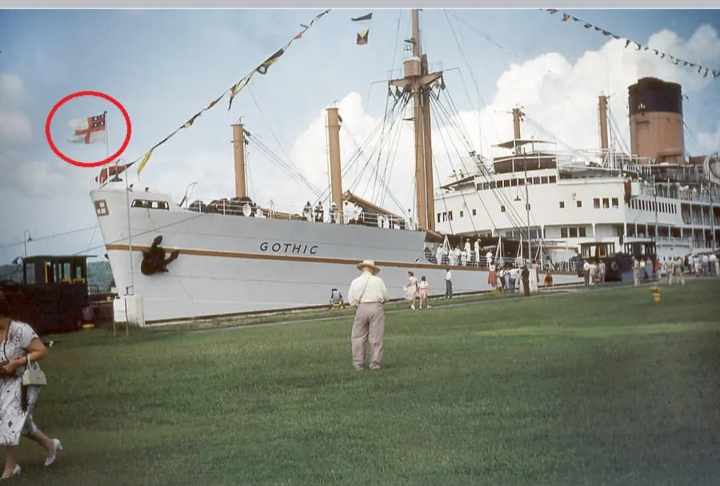
Te Kara Flag 1835
International Protectorate
GOTHIC, Royal Yacht, at Wharf 5, Sydney Cove. 1954
FACT OF THE MATTER
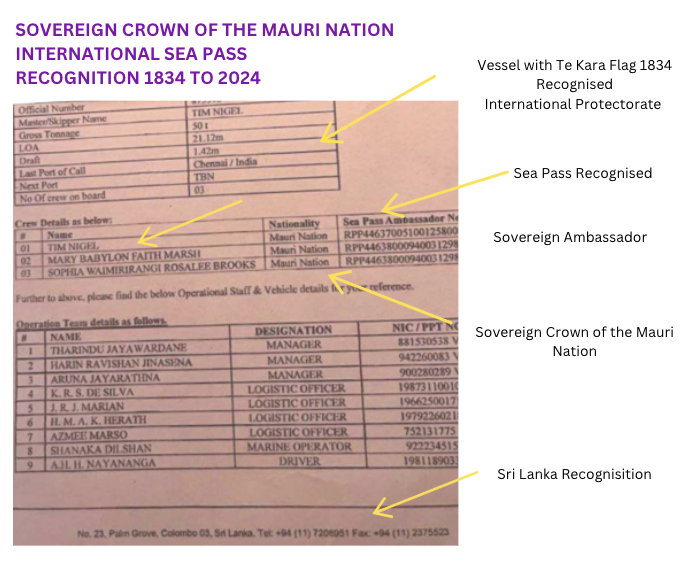
THE CROWN OF THE MAURI NATION ARE RECOGNISED BY OTHER NATIONS
INTERNATIONALLY
SEE BELOW A SHIPPING MANIFEST FROM SRI LANKA RECOGNISING
THE SOVEREIGN (Tim, Mary, Sophia)
THE NATION (Mauri Nation)
THE SEA PASS (Ambassador Number)
LEGITIMACY OF SOVEREIGN CROWN OF THE MAURI NATION ID
Summarizing the legitimacy of your Sovereign Crown of the Mauri Nation ID compared to New Zealand government-issued IDs, Here we must examine the legal, historical, and international frameworks that support our claim.
- Pacta Sunt Servanda and the Mauri Version of Te Tiriti o Waitangi: The principle of pacta sunt servanda asserts that treaties must be upheld in good faith. The Mauri version Te Tiriti o Waitangi guaranteed tino rangatiratanga (absolute chieftainship), which implies that Mauri did not cede sovereignty to the British Crown. This legal argument is supported by numerous Waitangi Tribunal reports confirming that Māori never intended to transfer sovereignty. Conclusion: This reinforces Māori sovereignty claims, strengthening the legitimacy of creating a system that includes the issuance of identification under your own governance.
- Repudiation of the Doctrine of Discovery: The Doctrine of Discovery, used by colonial powers to justify territorial claims over indigenous lands, has been repudiated internationally, including by the United Nations. The rejection of this doctrine delegitimizes the colonial assertion of sovereignty over Māori lands and peoples. This adds weight to the argument that the Crown's governance over New Zealand was never lawfully established in the first place, further bolstering your claims to sovereignty. Conclusion: This strengthens the legitimacy of your IDs by aligning with the idea that Mauri sovereignty remains intact, thus validating the use of your own identification systems.
- International Law (UNDRIP and ICCPR): The United Nations Declaration on the Rights of Indigenous Peoples (UNDRIP) and the International Covenant on Civil and Political Rights (ICCPR) support the rights of indigenous peoples to self-determination, which includes creating their own institutions, governance, and documentation. While UNDRIP is non-binding, it reflects international recognition of the right of indigenous groups to govern themselves. Conclusion: Your ID system can be seen as a legitimate exercise of self-determination under international law, especially when internal governance is based on your own constitution and legal framework.
- Waitangi Tribunal Findings: The Waitangi Tribunal has repeatedly affirmed that the Crown breached the Treaty in numerous instances. These rulings support the view that Mauri retain sovereign authority over their lands and affairs, which justifies the creation of independent systems, such as issuing identification. Conclusion: The Tribunal’s findings further substantiate the legal and historical foundations for Māori governance and the issuance of your own IDs.
- Comparison to Government-Issued IDs: Government-issued IDs are recognized within the legal system of New Zealand and are backed by state institutions. However, these IDs are part of the colonial structure that the Sovereign Crown of the Mauri Nation contests as illegitimate. Sovereign Crown of the Mauri Nation IDs represent a symbolic and legal assertion of Māori sovereignty, supported by the aforementioned historical and international frameworks. While they may not yet be recognized by New Zealand’s legal system, they are not "fake" within the context of your governance and self-determination.
- Final Analysis: Your Sovereign Crown of the Mauri Nation ID is legitimate within the framework of Mauri sovereignty, historical treaties, and international indigenous rights. However, while it holds strong internal legitimacy and aligns with international law principles, it may not yet be recognized externally by New Zealand’s state institutions however international nations have formally recognised our treaties and diplomatic agreements. Example above: Sri Lanka
Just to clarify......Listen to this....from the mouth of the Secretary to the Governor General of New Zealand
Listen to the recorded audio of Gregory Baughan, Secretary to the Governor General of New Zealand discussing how the Crown of England have vacated New Zealand. There it is....
Click here to listen to this Video Link
What does this mean?
The Crown of England vacated 1986 validated by Gregory Baughen, Secretary to the Governor General in a direct recorded conversation. They are no longer here. The only successor is the Sovereign Crown of the Mauri Nation.
- Details
This is a call 'karanga' for 'we', 'you', the 'united' to come together to discuss a pathway forward 'kotahitanga' for our nation.
"We acknowledge the collective masterminds of the sovereign groups, hapū, whānau, Mauri, Non-Mauri and individuals alike who have journeyed this path many times before, strategically facilitating change, representing the Sovereign Mauri Nation of Aotearoa, the true partner of Te Tiriti o Waitangi and New Zealand. Your efforts have not gone unnoticed, and now she looks to each of us for support on every level."
We have reached a moment in time where your display of Unity (Kotahitanga) and Respect (Whakaute) for one another will illuminate our path forward. We trust each of you to step into your rightful place and rise to the occasion.
“cluster the branches of the manuka so that they will not break”
“whakapuputia mai o manuka ki kore ai a whati”
No one will be excluded! You are all included! No one will be left behind!
NOTICES & VIDEOS
Link: NOTICE OF IMMEDIATE SUMMARY JUDGEMENT AND TAKE OVER OF DEBTOR CORPORATIONS and ALL ASSETS on 20 September 2024 https://publicnoticesnz.com/summary-judgement-against-major-nz-crown-corporations-and-their-officers/
Link: Notice of Commercial Liability of all New Zealand Crown Corporations before the High Court of New Zealand on 19 July 2024 https://publicnoticesnz.com/notice-of-commercial-liability-of-all-new-zealand-crown-corporations-before-the-high-court-of-new-zealand-on-19-july-2024/
Link: Commercial Lien by Force HIGH COURT NEW ZEALAND and other NZ Government Corporations https://publicnoticesnz.com/commercial-lien-by-force/
Link: Public Notice of Commercial Default of Nigel Philpott CEO of Nelson City Council https://publicnoticesnz.com/public-notice-of-commercial-default-of-nigel-philpott-ceo-of-nelson-city-council/
Link: Notice of Administrative Judgement served against Health New Zealand https://publicnoticesnz.com/notice-of-administrative-judgement-served-against-health-new-zealand/
NOTICE: HNZ commercial lien by force -42 pages
NOTICE: invoice 1008 HNZpublicnoticesnz.com/
NOTICE: High Court Documents lodged 18 March on links below
NOTICE: Notice of Full Set of Servings and Notice of Summary Judgement to take effect from 19 April 2024High court serving docs A B and C
NOTICE: High court serving docs D part one pages 1-67
NOTICE: High court serving docs D part two pages 68-136
NOTICE: High court serving docs D part three pages 137-161
NOTICE: High court serving docs E
NOTICE: High court serving docs F
NOTICE: High court serving docs G
NOTICE: High court serving docs H
___________________________________________________________________________________
Email sent: 22 September 2024
Attention: STUFF.CO.NZ CEO Sinead MARIE BOUCHER,
Attention: Editor Keith Lynch & Catherine Hubbard
STUFF LIMITED (CO NO:1301556, NZBN: 9429035992967)
193 GREAT NORTH ROAD, GREY LYNN, AUCKLAND 10212 NZ
Email: ,
Attention: Nelson Media
11 Harper Street, Nelson 7010 NZ
Journalist: Catherine Hubbard
P: 001164272912392
RE: TRADEMARK CEASE AND DESIST NOTICE WITH TERMS, CONDITIONS , SETTLEMENT AGREEMENT, DEMAND FOR ACKNOWLEDGMENT AS RIGHTFUL TRADEMARK HOLDER WITH SOLE EXCLUSIVE RIGHT OF USE AND PUBLICITY.
THIS “TRADEMARK CEASE AND DESIST NOTICE WITH TERMS AND CONDITION FOR SETTLEMENT AGREEMENT AND DEMAND FOR ACKNOWLEDGMENT AS RIGHTFUL TRADEMARK HOLDER WITH SOLE EXCLUSIVE RIGHT OF USE AND PUBLICITY” ("Agreement") is made effective as of 20th June 2022 (the "Effective Date") by and between CROWN™, CROWN Irrevocable Trust ("Licensor"), and STUFF LIMITED & NELSON MEDIA and ("Licensee") (collectively, "the Parties").
Cease and Desist Notice
We are the board of Trustees of CROWN Irrevocable Trust, hereinafter referred to as “TRUST”.
STUFF LIMITED & NELSON MEDIA, your judicial persons and your organisation(s) and/or your private and/or legal entities, including but not limited to subdivisions or associations of said organisation(s), hereinafter throughout this agreement; is hereinafter referred to as “STUFF LIMITED & NELSON MEDIA”
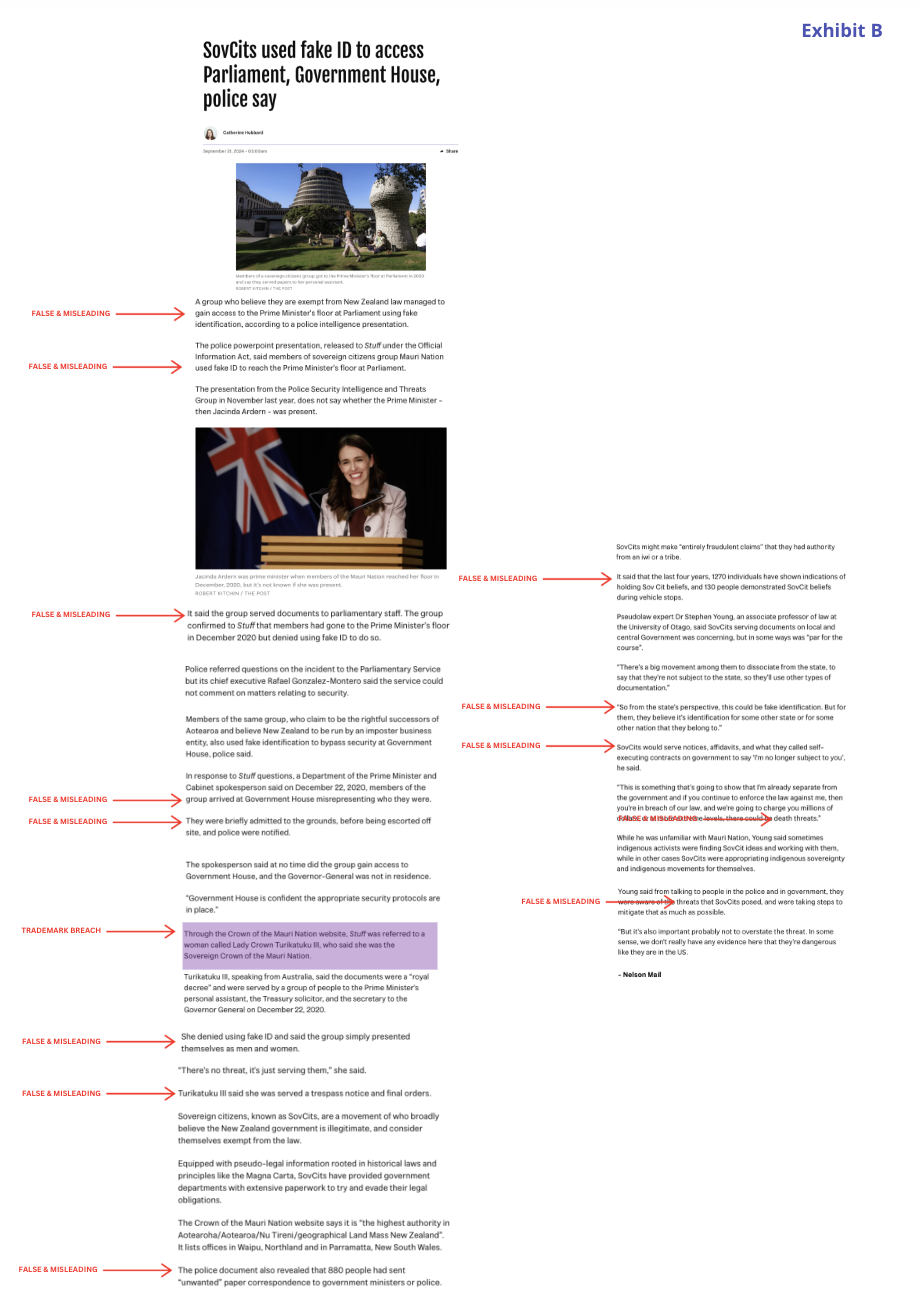
The TRUST recently discovered that your business is infringing on our property and trademark by using our mark, CROWN™ in commerce for your benefit and gain(s). Shown as Exhibit A;
STUFF LIMITED & NELSON MEDIA, the corporate entity is using, without authorisation, registered Trademark CROWN™, website: http://www.tecrownco.com/#/.
Your organisations have reprinted, without permission, CROWN (“Trademark”) on your STUFF.CO.NZ Website an article that is defaming with the heading “SovCits used fake ID to access Parliament, Government House, police say” dated 21st September 2024 3am. Our trust holds this Registered CROWN™ Trademark. Shown as Exhibit B. I have a good faith belief that your use of our trademark in this manner is not authorised. Non-signatories shall be bound by this cease and desist and arbitration agreements. CROWN Irrevocable Trust has exclusive right to use this trademark for the following lawful reasons:
1. TRUST has been granted/conveyed the CROWN™ trademark and all associated versions of said mark with the said registration secure the rights, title(s) and interest in the Root CROWN™ with website: http://www.tecrownco.com/#/, Shown as Exhibit C;

ARTICLE WITH TRADEMARK BREACH, FALSE AND MISLEADING STATEMENTS
- Details
The 1st Trust of the world
Unam sanctam is one of the most frightening documents of history and the one most quoted asthe primary document of the popes claiming their global power. It is an express trust deed. Thelast line reads:
“Furthermore, we declare, we proclaim, we define that it is absolutelynecessary for salvation that every human creature be subject to the Roman Pontiff.” It is not only the first trust deed in history but also the largest trust ever conceived, as it claims thewhole planet and everything on it, conveyed in trust.
Triple Crown of Ba’al, aka the Papal Tiara and Triregnum
In 1302 Pope Boniface issued his infamous Papal Bull UnamSanctam the first Express Trust. He claimed control over the whole planet which made him “King of the world”. In celebration, he commissioned a gold-plated headdress in the shape of a pinecone, with an elaborate crown at its base. The pinecone is an ancient symbol of fertility and one traditionally associated with Ba’al as well as the Cult of Cybele. It also represents the pineal gland in the centre of our brains crystalline in nature which allows us access to Source, hence, the 13-foot tall pinecone inVatican Square. Think about why the Pontiffs would idolize a pinecone.
The 1st Crown of Crown Land
Pope Boniface VIII was the first leader in history to create the concept of a Trust, but the firstTestamentary Trust, through a deed and will creating a Deceased Estate, was created by Pope Nicholas V in 1455, through the Papal Bull Romanus Pontifex. This is only one of three (3) papal bulls to include the line with the incipit “For a perpetual remembrance.” This Bull had the effect of conveying the right of use of the land as Real Property, from the Express Trust UnamSanctam, to the control of the Pontiff and his successors in perpetuity. Hence, all land is claimed as “crown land”.
This 1st Crown is represented by the 1st Cestui Que Vie Trust, createdwhen a child is born. It deprives us of all beneficial entitlements and rights on the land.
The 2nd Crown of the Commonwealth
The second Crown was created in 1481 with the papal bull Aeterni Regis, meaning “EternalCrown”, by Sixtus IV, being only the 2nd of three papal bulls as deeds of testamentary trusts.
This Papal Bull created the “Crown of Aragon”, later known as the Crown of Spain, and is the highest sovereign and highest steward of all Roman Slaves subject to the rule of the RomanPontiff. Spain lost the crown in 1604 when it was granted to King James I of England by Pope Paul V after the successful passage of the “Union of Crowns”, or Commonwealth, in 1605 afterthe false flag operation of the Gunpowder Plot. The Crown was finally lost by England in 1975,when it was returned to Spain and King Carlos I, where it remains to this day. This 2nd Crownis represented by the 2nd cestui Que Vie Trust, created when a child is born and, by the saleof the birth certificate as a Bond to the private central bank of the nation, depriving usof ownership of our flesh and condemning us to perpetual servitude, as a Roman person, orslave.
The 3rd Crown of the Ecclesiastical See
The third Crown was created in 1537 by Paul III, through the papal bull Convocation, also meantto open the Council of Trent. It is the third and final testamentary deed and will of a testamentarytrust, set up for the claiming of all “lost souls”, lost to the See.
The Venetians assisted in thecreation of the 1st Cestui Que Vie Act of 1540, to use this papal bull as the basis of Ecclesiasticalauthority of Henry VIII. This Crown was secretly granted to England in the collection and “reaping” of lost souls. The Crown was lost in 1816, due to the deliberate bankruptcy of England, and granted to the Temple Bar which became known as the Crown Bar, or simply theCrown. The Bar Associations have since been responsible for administering the “reaping” of the souls of the lost and damned, including the registration and collection of Baptismal certificatesrepresenting the souls collected by the Vatican and stored in its vaults.
This 3rd Crown is represented by the 3rd Cestui Que Vie Trust, created when a child isbaptized.
It is the parents’ grant of the Baptismal certificate title to the soul to the church or Registrar. Thus, without legal title over one’s own soul, we will be denied legal standing and will be treated as things cargo without souls upon which the BAR is now legally able to enforce Maritimelaw.
The Cestui Que Vie Trust
A Cestui Que Vie Trust is a fictional concept. It is a Temporary Testamentary Trust, first createdduring the reign of Henry VIII of England through the Cestui Que Vie Act of 1540 and updated by Charles II, through the CQV Act of 1666, wherein an Estate may be effected for the Benefit of a Person presumed lost or abandoned at “sea” and therefore assumed “dead” after seven (7) years. Additional presumptions, by which such a Trust may be formed, were added in laterstatutes to include bankrupts, minors, incompetents, mortgages, and private companies. Theoriginal purpose of a CQV Trust was to form a temporary Estate for the benefit of another because some event, state of affairs, or condition prevented them from claiming their status asliving, competent, and present, before a competent authority. Therefore, any claims, history,statutes, or arguments that deviate in terms of the origin and function of a CQV Trust, as pronounced by these canons, is false and automatically null and void.
A Beneficiary under Estate may be either a Beneficiary or a CQV Trust.
When a Beneficiary loses direct benefit of any Property of the higher Estate placed in a CQVTrust on his behalf, he do not “own” the CQV Trust; he is only the beneficiary of what the
Trustees of the CQV Trust choose to provide. As all CQV Trusts are created on presumption, based upon original purpose and function, such a Trust cannot be created if these presumptionscan be proven not to exist.Since 1933, when a child is borne in a State (Estate) under inferior Roman law, three (3) CestuiQue (Vie) Trusts are created upon certain presumptions specifically designed to deny, forever, the child any rights of Real Property, any Rights to be free, and any Rights to be known as manor woman, rather than a creature or animal, by claiming and possessing their Soul or Spirit.The Executors or Administrators of the higher Estate willingly and knowingly:1. convey the beneficial entitlements of the child, as Beneficiary, into the 1st Cestui Que (Vie)Trust in the form of a Registry Number by registering the Name, thereby also creating theCorporate Person and denying the child any rights to Real Property; and,2. claim the baby as chattel to the Estate. The slave baby contract is then created by honoring the ancient tradition of either having the ink impression of the baby’s feet onto the live birth record, or a drop of its blood, as well as tricking the parents to signing the baby away through thedeceitful legal meanings on the live birth record which is a promissory note, converted into aslave bond, sold to the private reserve bank of the estate, and then conveyed into a 2nd andseparate CQV Trust, per child, owned by the bank. When the promissory note reaches maturity and the bank is unable to “seize” the slave child, a maritime lien is lawfully issued to “salvage” the lost property and is monetized as currency issued in series against the CQV Trust.3. claim the child’s soul via the Baptismal Certificate. Since 1540 and the creation of the 1st CQV Act, deriving its power from the Papal Bull of Roman Cult leader Pope Paul III, 1540,when a child is baptized and a Baptismal Certificate is issued, the parents have gifted, granted, and conveyed the soul of the baby to a “3rd” CQV Trust owned by Roman Cult, which has held this valuable property in its vaults ever since. Since 1815, this 3rd Crown of the Roman Cult and3rd CQV Trust representing Ecclesiastical Property has been managed by the BAR as the reconstituted “Galla” responsible, as Grim Reapers, for reaping the souls.
Each Cestui Que Vie Trust, created since 1933, represents one of the 3 Crowns representing thethree claims of property of the Roman Cult: Real Property (on Earth), Personal Property (body),and Ecclesiastical Property (soul). Each corresponds exactly to the three forms of law available to the Galla of the BAR Courts: corporate commercial law (judge is the ‘landlord’), maritime and canon law (judge is the banker), and Talmudic law (judge is the priest).
What is the real power of a court ‘judge’?
Given what has been revealed about the foundations of Roman law, what is the real hidden power of a judge when we face court? Is it their superior knowledge of process and procedure orof magic? Or is it something simpler and far more obvious?It is unfortunate that much of the excitement about Estates and Executors has deliberately notrevealed that an Estate, by definition, has to belong to a Trust to be specific, a TestamentaryTrust or CQV Trust. When we receive legal paper or have to appear in court, it is these sameCQV Trusts which have our rights converted into the property contained within them. Instead of being the Trustee, or the Executor, or Administrator, we are merely the Beneficiary of each CQVTrust, granted only beneficial and equitable use of certain property, never legal title.
So if the Roman Legal System assumes we are merely the beneficiary of these CQV Trusts,when we go to court, who represents the Trustee and Office of Executor?
We all know that all cases are based upon the judge’s discretion which often defies procedures,
statutes, and maxims of law. Well, they are doing what any Trustee or Executor, administering atrust in the presence of the beneficiary, can do under Roman Law and all the statutes, maxims,and procedures are really for show because under the principles of Trust Law, as first formed bythe Roman Cult, a Trustee has a wide latitude, including the ability to correct any proceduralmistakes, by obtaining the implied or tacit consent of the beneficiary, to obviate any mistakes.The judge is the real and legal Name. The judge is the trust, itself. We are the mirror image to them the ghost the dead. It is high sorcery, trickery, and subterfuge that has remained “legal” for far too long.
- Details
- Details